200 Sudoku Puzzles for Kids 6x6 Vol.18
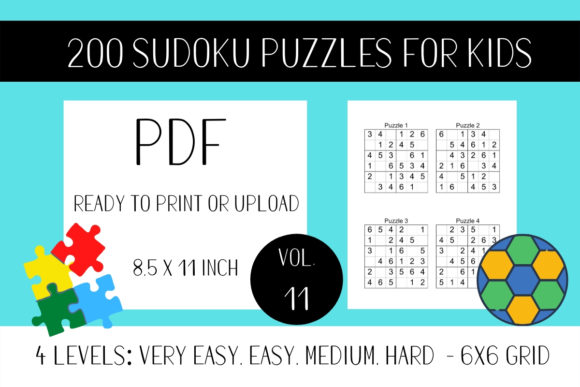
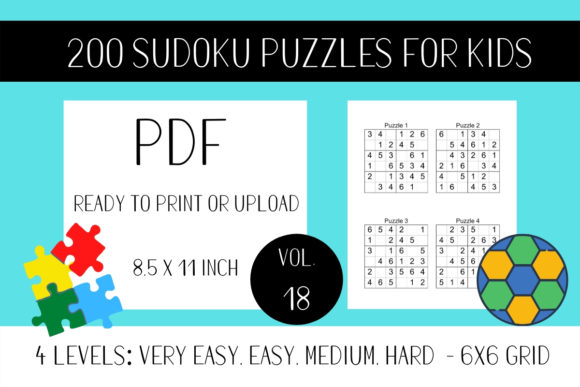
Creating engaging, age-appropriate activity books requires more than just generating random grids; it demands a thoughtful approach to layout, pacing, and visual hierarchy. 200 Sudoku Puzzles for Kids 6x6 Vol.18 serves as a comprehensive digital asset designed specifically for publishers, educators, and content creators targeting early elementary audiences. This ready-to-print PDF puzzle book offers a structured solution for those developing cognitive resources for children aged five to eight. Unlike standard adult sudoku which utilizes a complex 9x9 matrix, this volume employs a simplified 6x6 grid that reduces cognitive load while maintaining the core logic-building benefits of the game.
The personality of this collection is rooted in accessibility and encouragement. Visually, the 6x6 format creates a less intimidating entry point for young learners who are still developing number recognition and spatial reasoning skills. The design prioritizes clarity over decoration, ensuring that the focus remains on the problem-solving process rather than distracting graphics. For designers and self-publishers, this clean aesthetic functions similarly to a well-crafted sans serif font in editorial design: it provides a neutral, highly readable foundation that allows the content to breathe. The overall appeal lies in its balance between challenge and achievability, fostering a sense of competence in young users without causing frustration.
Strategic Applications in Publishing and Education
While primarily an activity book, the structural principles applied in 200 Sudoku Puzzles for Kids 6x6 Vol.18 mirror best practices found in professional typography and brand identity development. Just as a designer selects a specific typeface to influence readability and audience perception, this puzzle collection uses grid density and spacing to guide user engagement. It works exceptionally well across various creative and commercial projects where cognitive development is the primary value proposition.
- Homeschool Curriculum Supplements: The 6x6 format aligns perfectly with kindergarten and first-grade math standards regarding patterns and logic. The consistent layout allows parents and educators to integrate these pages seamlessly into daily lesson plans without needing to reformat or adjust margins.
- Print-on-Demand (POD) Products: For entrepreneurs utilizing platforms like Amazon KDP or Lulu, this 84-page PDF is formatted to industry standards. The 8.5″ x 11″ trim size and pre-set margins eliminate common formatting errors, making it an ideal base for creating low-content books or bundling with other educational assets.
- Digital Learning Platforms: Content creators can extract individual puzzles for use in tablet-based learning apps or interactive whiteboard sessions. The high-resolution vector-style lines ensure that grids remain crisp when scaled for different screen sizes, much like how a premium display font retains integrity across web and print media.
- Therapeutic and Special Education Resources: Occupational therapists and special education teachers often require materials with reduced visual clutter. The straightforward grid design supports executive function training without the sensory overload associated with heavily illustrated script font headers or chaotic layouts.
Layout Dynamics and Visual Hierarchy
The effectiveness of any educational material depends heavily on how information is organized. In 200 Sudoku Puzzles for Kids 6x6 Vol.18, the decision to place four puzzles per page is a deliberate choice that influences both usability and production economics. From a publishing perspective, this density maximizes paper efficiency, keeping the total page count at a manageable 84 pages while delivering substantial content value. For the end-user, specifically a child with limited attention span, four distinct tasks per page provide clear start and stop points, preventing the feeling of being overwhelmed by an endless sea of grids.
This layout strategy parallels the concept of visual hierarchy in web design and packaging design. Just as a designer uses whitespace and font weight to direct the eye through a landing page, the spacing between these sudoku grids creates natural pauses. The inclusion of six answer keys per page further enhances the user experience by consolidating reference material. This prevents the need for excessive page flipping, maintaining the flow state essential for deep engagement. When evaluating this asset against other market options, consider how this specific arrangement supports sustained attention compared to single-puzzle-per-page formats that may feel sparse or inefficient.
Evaluating Fit for Commercial and Creative Projects
Selecting the right puzzle asset is akin to choosing the correct commercial font for a branding project; it must align with your audience's developmental stage and your product's intended use case. Before integrating 200 Sudoku Puzzles for Kids 6x6 Vol.18 into your portfolio, assess whether the 6x6 complexity matches your target demographic. If your audience is transitioning from basic number tracing to logical deduction, this volume hits the sweet spot. However, if you are targeting advanced learners aged nine and up, you might need to pair this with 9x9 variants to maintain engagement, similar to how a designer pairs a handwritten font with a structured serif font to create dynamic contrast.
Testing is crucial. Print sample pages to evaluate line weight and contrast. Ensure the grid lines are dark enough for pencil marks but light enough not to compete with handwritten numbers. This tactile verification is as important as testing font pairings on different paper stocks. Additionally, review the licensing terms carefully. Understanding whether you have rights for unlimited commercial reproduction, modification, or digital distribution protects your business from future legal complications. Treat this PDF as a foundational design asset; while it is ready to use immediately, its true value emerges when you understand its parameters and adapt it thoughtfully within your broader content strategy.
Practical Recommendations for Implementation
To maximize the utility of this resource, consider the context in which it will be consumed. If using this for a physical workbook, ensure your binding method accommodates the 8.5″ x 11″ format without obscuring the inner margins where puzzles are located. For digital adaptations, test the PDF on multiple devices to verify that the interactive elements (if added later) align correctly with the static grid. Remember that consistency builds trust; using this volume as part of a series establishes a recognizable brand identity for your educational products. Parents and educators look for reliable, predictable quality, and maintaining uniform styling across volumes reinforces that professionalism.
Ultimately, 200 Sudoku Puzzles for Kids 6x6 Vol.18 represents more than just a collection of games; it is a carefully calibrated tool for cognitive development wrapped in a production-ready package. By understanding its visual characteristics, optimal applications, and layout logic, creators can leverage this asset to build meaningful, engaging experiences that respect both the learner's journey and the publisher's operational needs. Whether you are designing a new curriculum, launching a POD business, or creating supplemental therapy materials, approaching this resource with the same rigor applied to modern typography and editorial design ensures outcomes that are both aesthetically pleasing and functionally superior.