Evaluating 200 Sudoku Puzzles for Kids 6x6 Vol.11: A Practical Resource Guide
Selecting the right cognitive development tools for children often requires balancing engagement with educational value. When evaluating printable resources, specificity in format and difficulty progression becomes a primary decision factor. 200 Sudoku Puzzles for Kids 6x6 Vol.11 represents a targeted solution within the broader category of logic puzzles, specifically designed for early learners transitioning from basic pattern recognition to structured deductive reasoning. Unlike standard 9x9 grids intended for adults or older students, this resource utilizes a 6x6 matrix that reduces cognitive load while maintaining the core logical mechanics of Sudoku.
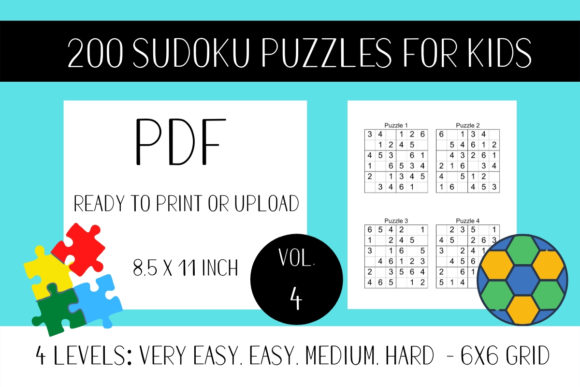
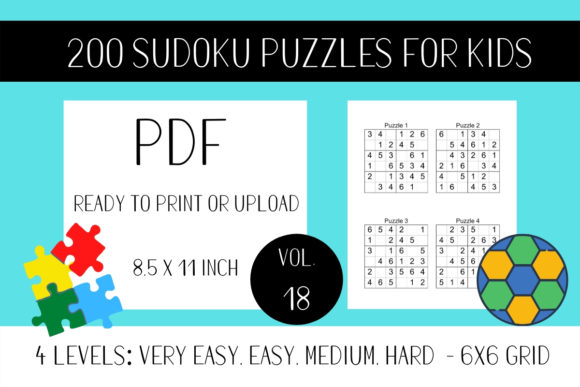
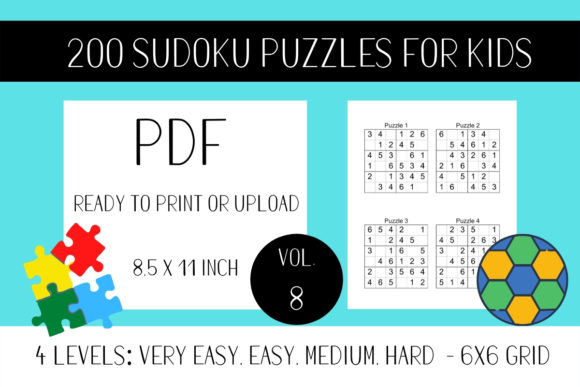
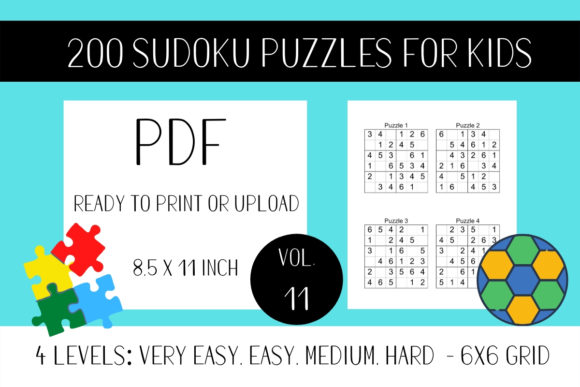
This digital PDF resource offers a distinct set of specifications that differentiate it from generic puzzle books. It contains 84 pages formatted at 8.5″ x 11″, optimized for standard home printing. The layout features four puzzles per page alongside six answer keys per page, creating a high-density value proposition for users who manage their own printing supplies. Understanding these technical parameters is essential for determining whether this specific volume aligns with your current educational goals, budget constraints, and the learner's developmental stage.
Distinguishing Features of the 6x6 Format
The choice of a 6x6 grid is not merely an aesthetic preference; it is a pedagogical scaffold. Standard Sudoku uses numbers 1 through 9 across nine rows, columns, and 3x3 subgrids. For children aged 5 to 8, or those new to logic puzzles, tracking nine variables simultaneously can lead to frustration rather than learning. 200 Sudoku Puzzles for Kids 6x6 Vol.11 restricts the variable set to numbers 1 through 6, organized into 2x3 rectangular regions. This reduction decreases the working memory required to solve each puzzle, allowing young solvers to focus on the logic of elimination and placement rather than being overwhelmed by data volume.
When comparing this format to other introductory logic games, such as maze books or simple crosswords, the 6x6 Sudoku offers superior transferability to mathematical thinking. Mazes develop spatial awareness, and crosswords build vocabulary, but neither reinforces the concept of unique constraints within intersecting sets. The 6x6 format serves as a direct bridge to algebraic thinking and set theory fundamentals. However, it is important to note that this format has a lower ceiling for complexity than 9x9 grids. Advanced learners may exhaust the challenge level of this volume more quickly, making it a transitional tool rather than a permanent fixture in a long-term curriculum.
Volume Structure and Print Efficiency Analysis
Efficiency in printable resources is measured by content density and ease of use. Many downloadable puzzle packs suffer from excessive white space or inefficient layouts that waste ink and paper. This volume addresses those concerns through a specific layout architecture:
- Four Puzzles Per Page: This density maximizes the utility of each printed sheet. For classroom settings or homeschool environments where multiple children are working simultaneously, a single printout can be cut into quarters, reducing paper consumption by 75% compared to single-puzzle layouts.
- Six Answers Per Page: Separating answer keys from the puzzle pages prevents accidental spoilers during active solving. The consolidation of six answer sets per key page allows parents or educators to verify work rapidly without flipping through dozens of pages.
- 84-Page Total Length: At 200 puzzles distributed across 84 pages, the file size remains manageable for most devices and printers, avoiding the lag issues sometimes associated with high-resolution graphic-heavy PDFs.
Users should compare this efficiency against subscription-based puzzle apps. While apps offer interactivity and instant feedback, they lack the tactile benefit of writing and erasing, which supports fine motor skill development. Furthermore, the one-time cost of a PDF like 200 Sudoku Puzzles for Kids 6x6 Vol.11 typically undercuts monthly app subscriptions, making it economically preferable for families seeking screen-free alternatives.
Assessing Difficulty Progression and Skill Fit
A critical evaluation metric for any puzzle collection is the integrity of its difficulty curve. Resources labeled "for kids" often fail to provide meaningful progression, offering either uniform simplicity or erratic spikes in complexity. This volume includes four distinct difficulty levels, which facilitates differentiated instruction. This structure allows adults to assess a child’s current baseline and assign appropriate challenges without trial-and-error guessing.
For educators or parents managing multiple age groups, this tiered approach enables the same physical book to serve different learners. A six-year-old might engage exclusively with Level 1 and 2 puzzles to build confidence, while an eight-year-old could tackle Levels 3 and 4 to refine speed and accuracy. However, buyers must realistically assess the upper limit of these levels. "Hard" in a 6x6 context does not equate to "Hard" in adult Sudoku. If the target user already solves standard newspaper Sudoku comfortably, this volume will likely be too elementary. It is best suited for beginners, early elementary students, or individuals requiring cognitive rehabilitation exercises that do not demand high-level processing speed.
Comparing Digital PDFs vs. Traditional Bound Books
The decision between purchasing a ready-to-print PDF and a pre-bound paperback involves tradeoffs regarding convenience, customization, and cost. Understanding these differences helps determine if 200 Sudoku Puzzles for Kids 6x6 Vol.11 is the optimal format for your situation.
- Customization Capability: The PDF format allows selective printing. If a child struggles with a specific difficulty level, you can reprint those specific pages indefinitely. With a bound book, once a page is completed or damaged, it cannot be replaced without repurchasing the entire volume.
- Immediate Availability: Digital delivery eliminates shipping wait times. This is particularly relevant for last-minute travel preparation, unexpected school closures, or immediate lesson planning needs.
- Production Responsibility: The tradeoff for flexibility is labor. You must supply paper, ink, and potentially binding equipment (stapler, hole punch, or comb binder). If you lack access to a reliable printer or find assembly tedious, a pre-printed book may offer better user experience despite the higher upfront cost.
- Cost Per Puzzle: When factoring in ink and paper costs, the total expense of a printed PDF can approach that of a mass-market paperback. However, the ability to reuse the master file for multiple children or future students significantly lowers the long-term cost-per-use ratio.
Practical Use Cases and Limitations
Identifying the ideal environment for this resource ensures realistic expectations. 200 Sudoku Puzzles for Kids 6x6 Vol.11 excels in specific scenarios while presenting limitations in others.
Ideal Scenarios:
- Homeschool Logic Blocks: The 4-puzzle-per-page layout fits neatly into daily worksheet packets or morning warm-up routines.
- Travel and Waiting Rooms: Printing a subset of 10-20 pages creates a lightweight, disposable activity pack that avoids the bulk of carrying full books.
- Classroom Centers: Teachers can laminate individual puzzle cards created from the PDF for reusable dry-erase stations.
- Screen-Free Transition Activities: Provides a structured, quiet-focus alternative to tablets during downtime.
Potential Limitations:
- Lack of Instructional Content: As a pure puzzle collection, it assumes prior knowledge or external teaching. It does not include tutorials on Sudoku strategies. Adults may need to supplement with verbal instruction or video demonstrations for absolute beginners.
- Visual Uniformity: The black-and-white, text-focused design prioritizes function over entertainment. Children accustomed to colorful, character-driven activity books may initially find the aesthetic less engaging. Parental encouragement or gamification (e.g., timing challenges, reward systems) may be necessary to maintain interest.
- Finite Content: With exactly 200 puzzles, regular users (e.g., one puzzle daily) will complete the volume in approximately seven months. Planning for subsequent volumes or alternative resources is necessary for continuous engagement.
Making an Informed Selection Decision
Ultimately, the suitability of 200 Sudoku Puzzles for Kids 6x6 Vol.11 depends on aligning product specifications with user needs. It is a functional, no-frills resource optimized for volume practice and logistical flexibility. Buyers prioritizing low cost-per-unit, print-on-demand versatility, and age-appropriate cognitive scaffolding will find significant value. Conversely, those seeking guided instruction, premium visual design, or advanced challenge levels should explore alternative formats or supplementary materials.
Before purchasing, verify your printing capabilities and assess the learner’s current logic skills against the 6x6 parameter. Consider downloading a sample page if available to test readability and layout compatibility with your hardware. By treating this PDF as a specialized tool within a broader educational toolkit rather than a standalone solution, you maximize its effectiveness in developing foundational logical reasoning skills. The decision should rest on whether the tradeoff of self-production yields sufficient benefits in customization and economy for your specific context.