Maintenance Log Book KDP Interior: Streamlining Low-Content Publishing Workflows
Creating a profitable low-content book on Amazon KDP requires more than just a creative cover; it demands a functional, high-quality interior that solves a specific problem for the end user. The Maintenance Log Book KDP Interior serves as a foundational asset for publishers targeting vehicle owners, property managers, equipment operators, and DIY enthusiasts. Rather than spending dozens of hours designing tables, lines, and headers from scratch, this pre-formatted template allows creators to bypass the technical design phase and focus immediately on niche research, keyword optimization, and marketing strategy. This resource is specifically engineered to integrate into a professional publishing workflow, reducing production time while ensuring the final product meets strict platform standards.
The Role of Pre-Formatted Interiors in Publishing Efficiency
In the context of self-publishing, time is often the most significant bottleneck. Designing a maintenance log from zero involves calculating bleed, setting margins, aligning grids, and testing print proofs. A dedicated Maintenance Log Book KDP Interior eliminates these friction points by providing a verified starting point. This asset fits into the broader publishing process during the production phase, acting as the bridge between niche selection and final upload. For entrepreneurs and freelancers managing multiple titles, this efficiency is not merely convenient; it is essential for scaling operations.
The inclusion of an editable source file in PowerPoint (pptx) format transforms this from a static template into a dynamic tool. While PDF files are excellent for direct upload, the PPTX file allows for strategic customization. Publishers can adjust column widths, modify header text to target specific sub-niches (such as "HVAC Equipment Maintenance" or "Classic Car Restoration"), or add branding elements without needing advanced graphic design software. This flexibility ensures that the interior remains relevant across various market segments while maintaining professional typographic standards.
Technical Specifications and Platform Compatibility
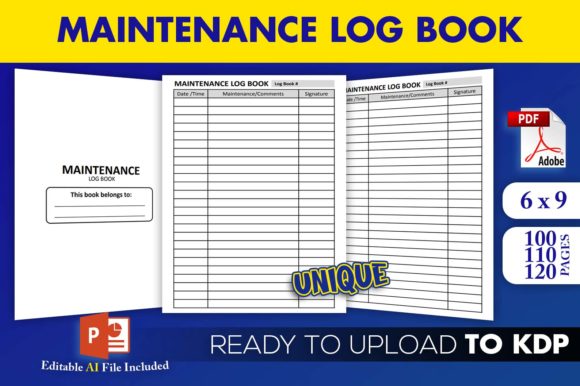
One of the primary risks in KDP publishing is file rejection due to formatting errors. This download package addresses that risk directly with interiors that have been tested on KDP. The trim size is set to 6×9 inches, which is the industry standard for portable logbooks. This size offers ample writing space while remaining compact enough for glove compartments, toolboxes, or clipboards. Understanding these physical constraints is vital for creating a product that users actually want to carry and use daily.
The package includes three distinct PDF files with page counts of 100, 110, and 120 pages. This variation is critical for workflow optimization. Different niches have different perceived value thresholds. A basic car maintenance tracker might perform best at 100 pages, keeping the printing cost low and the price point competitive. Conversely, a comprehensive facility management log may require 120 pages to justify a higher price point and meet user expectations for longevity. Having these options ready allows publishers to test different price-to-value ratios without additional design work.
- High-Resolution Output: All interiors are generated at professional print quality, ensuring crisp lines and legible text that does not pixelate when printed on standard KDP paper stock.
- Tested Margins and Bleed: Files are pre-configured to account for binding shifts, preventing content from being cut off or too close to the spine.
- Multiple Page Counts: Ready-to-upload variations allow for rapid A/B testing of book thickness and pricing strategies.
- Editable Source Material: The PPTX file provides full control over layout adjustments for niche-specific customization.
Integrating the Template into Niche Research and Development
A common mistake in low-content publishing is selecting a template before validating demand. The Maintenance Log Book KDP Interior should be deployed only after confirming that a specific audience exists. During the research phase, analyze competitor reviews to identify gaps in existing logbooks. Do users complain about insufficient space for notes? Are the columns too narrow for modern equipment serial numbers? Because you possess the editable PPTX source file, you can adapt the template to address these specific pain points before uploading.
This integration of research and production creates a feedback loop that improves product quality. For example, if research indicates that boat owners need specific fields for "Winterization" and "Launch Date," you can modify the generic maintenance template to include these headers. This level of specificity moves the product from a generic commodity to a tailored solution, significantly improving conversion rates. The template acts as a scaffold, allowing you to build a specialized product in a fraction of the time required for custom design.
Workflow Applications Before, During, and After Publication
The utility of this interior extends beyond the initial upload. Understanding where it fits in the lifecycle of a publishing business helps maximize return on investment.
Pre-Launch Preparation
Before publishing, use the high-resolution PDF files to create mockups and A+ Content. Since the interiors are already formatted and tested, you can confidently showcase the inside of the book in your marketing materials. This transparency builds trust with potential buyers who want to verify that the layout suits their needs. The consistency of the 6×9 trim size also simplifies the creation of lifestyle images and promotional graphics, as dimensions remain uniform across all three page-count variations.
Active Production and Customization
During the active publishing phase, the editable PPTX file serves as a master asset. If you are building a series of maintenance logs for different trades (e.g., plumbing, electrical, landscaping), maintain a consistent visual identity by using the same base template while swapping out terminology. This creates brand recognition across your catalog. Furthermore, if KDP updates its margin requirements or printing specifications, having the source file means you can update your entire catalog quickly rather than redesigning each book individually.
Post-Publication Analysis and Iteration
After launch, monitor sales data and customer feedback. If a specific page count outsells others, prioritize that version for future marketing efforts. If customers request additional features, return to the PPTX source file to create a "Version 2.0." This iterative process is only possible because the asset is editable. Static PDFs lock you into a single version; the included source file enables long-term product evolution based on real-world performance data.
Quality Control and Usability Considerations
Even with tested files, maintaining a rigorous quality control process is essential. Always order a physical proof copy before launching any modified version of the Maintenance Log Book KDP Interior. Digital previews cannot replicate the tactile experience of writing in a logbook. Check for line weight consistency, ensuring that writing lines are dark enough to see but light enough to write over. Verify that binding margins provide adequate clearance so the book lays flat when open—a crucial usability factor for maintenance professionals working in tight spaces.
Consider the end-user’s environment when finalizing your interior. Maintenance logs are often used in garages, construction sites, or outdoor settings. High-contrast designs with clear, bold headers improve readability in poor lighting conditions. The provided templates are designed with this practicality in mind, but any customizations made via the PPTX file should adhere to these usability principles. Avoid decorative fonts or overly complex table structures that might hinder quick data entry in field conditions.
Strategic Advantages for Diverse User Groups
This resource supports a wide spectrum of users within the self-publishing ecosystem. For freelancers and agencies offering KDP services, the tested interiors reduce delivery times and minimize revision cycles with clients. For small business owners creating branded logbooks for internal use or client giveaways, the editable format allows for logo placement and company-specific tracking fields without hiring a designer. For educators and trainers in vocational fields, these logs can be adapted into teaching tools for students learning equipment maintenance protocols.
The versatility of the Maintenance Log Book KDP Interior lies in its balance of structure and flexibility. It provides the technical safety net of a pre-tested file while retaining the creative freedom of an editable source. This combination allows users to maintain high production standards without sacrificing the ability to innovate. By treating this template as a core component of a larger publishing system rather than a standalone shortcut, creators can build sustainable, scalable businesses focused on delivering genuine value to specific audiences.
Maximizing Long-Term Asset Value
To get the most from this download, organize your digital assets systematically. Create a master folder structure that separates the original, unmodified files from your customized versions. Name files clearly with niche, trim size, and page count to prevent upload errors. Document any changes made to the PPTX file so you can replicate successful modifications in future projects. This organizational discipline prevents version confusion and ensures that your workflow remains efficient as your catalog grows.
Ultimately, the value of a Maintenance Log Book KDP Interior is measured by how effectively it enables you to serve your target market. The technical specifications, editable formats, and tested reliability are merely enablers; the true outcome is a published product that helps users track, maintain, and protect their valuable assets. By leveraging this resource strategically, publishers can shift their focus from pixel-pushing to market-building, creating better products faster and establishing a stronger presence in competitive niches.