Evaluating the KDP Gratitude Journal Interior for Low-Content Publishing
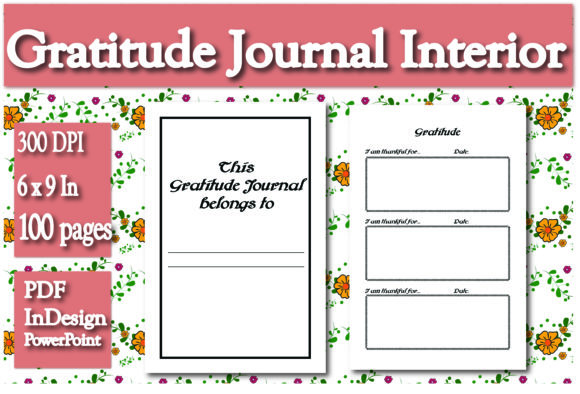
For self-publishers and digital product creators, sourcing high-quality interiors is often the bottleneck in scaling a low-content book business. The KDP Gratitude Journal Interior addresses this specific operational challenge by providing a pre-structured, 100-page layout designed specifically for the 6x9 inch trim size. Unlike generic templates found on free resource sites, this asset package includes editable source files in both Adobe InDesign and PowerPoint, alongside a print-ready PDF. This combination suggests a focus on workflow flexibility rather than just end-user consumption. For professionals ranging from freelance designers to educators building supplementary materials, the value proposition lies in the balance between immediate usability and long-term customization potential.
Technical Specifications and File Versatility
The inclusion of multiple file formats is the most significant functional aspect of this interior pack. While the PDF serves as the immediate deliverable for Amazon KDP upload or local printing, the source files determine the asset's longevity in a professional workflow. The 6x9 inch dimension is the industry standard for trade paperbacks in the mindfulness and journaling niche, offering a portable form factor that balances writing space with shelf presence.
The provision of an Adobe InDesign file caters to users who require typographic precision and master page management. InDesign allows for global style changes, ensuring that if you decide to alter the font hierarchy or margin guides across all 100 pages, the update is instantaneous and consistent. This is critical for maintaining visual coherence in a 100-page document where manual formatting would be prohibitively time-consuming. Conversely, the inclusion of a PowerPoint file lowers the barrier to entry for marketers, coaches, or small business owners who may not possess professional design software licenses. PowerPoint acts as a universal editor, allowing users to modify text, swap colors, or adjust spacing using familiar tools. This dual-format approach effectively segments the utility: InDesign for production-grade publishing and PowerPoint for rapid iteration or branded lead magnets.
Structural Analysis of the Interior Layout
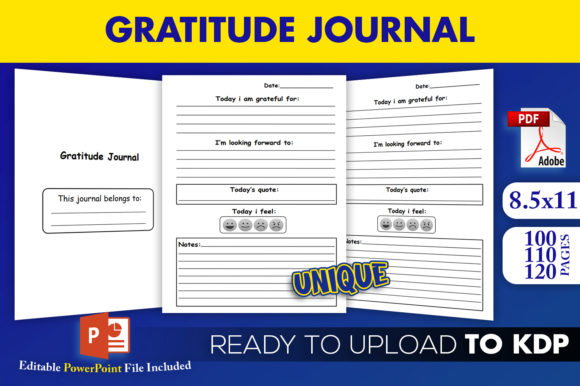
A gratitude journal fails if the user experience creates friction. This interior utilizes a streamlined structure composed of two primary elements: a "This Gratitude Journal belongs to" ownership page and recurring "I am thankful for" entry pages. From a usability standpoint, this minimalism is a strength. Complex prompts can sometimes deter daily use, whereas open-ended structures encourage consistency. The 100-page count provides approximately three months of daily entries or six months of alternate-day reflection, which aligns well with habit-formation timelines often cited in behavioral psychology literature.
The ownership page serves a practical purpose beyond personalization; it establishes the book as a tangible artifact, which is particularly relevant for creators selling physical copies or using them as corporate gifts. The recurring entry pages appear to utilize adequate whitespace and line spacing, essential factors for readability and writeability. When evaluating low-content interiors, one must verify that lines are not too faint for printing and that margins account for the gutter. A 6x9 book requires careful margin management to prevent text from disappearing into the binding, and this template appears calibrated for standard KDP binding specifications.
Workflow Integration and Customization Potential
For entrepreneurs and publishers, the true test of any template is how easily it integrates into existing production pipelines. The KDP Gratitude Journal Interior functions as a foundational layer rather than a finished product. This distinction is vital for avoiding market saturation. If you upload the PDF without modification, your product will be identical to every other buyer’s. However, the editable nature of the files supports differentiation strategies.
Professionals can leverage the source files to implement brand-specific changes. A life coach might add a weekly check-in section to the standard daily pages. A corporate wellness program could insert company values or specific reflection prompts relevant to their team culture. Educators might adapt the language for younger audiences or add instructional headers. Because the files are fully editable, these modifications do not require rebuilding the layout from scratch. This reduces development time from days to hours, significantly improving the return on investment for the asset. The ability to manipulate the master pages in InDesign or the slide master in PowerPoint ensures that repetitive elements remain aligned and consistent throughout the document, preserving a professional aesthetic even after heavy customization.
Print Readiness and Quality Assurance
The included PDF is described as ready for upload, but professional due diligence is always required. Before publishing, users should verify the bleed settings and color profile. KDP typically requires PDF/X-1a or high-resolution PDFs with embedded fonts. While the template is likely configured correctly, individual printer settings or export preferences can introduce errors. It is recommended to order a proof copy or use KDP’s previewer tool to check for margin warnings before making the title live. The 100-page length is also strategically sound for printing costs; it sits in a sweet spot where the spine is wide enough to display text clearly (unlike thinner journals) but thin enough to keep unit costs low, allowing for competitive pricing or higher royalty margins.
Audience Fit and Practical Applications
Determining whether this KDP Gratitude Journal Interior fits your needs depends largely on your technical capacity and end goal. The asset is best suited for three distinct user groups:
- Self-Publishers and KDP Authors: Those looking to expand their catalog quickly without hiring a designer. The template provides a professional baseline that meets platform requirements, allowing authors to focus on cover design and keyword research rather than interior formatting.
- Service Providers and Coaches: Professionals who use journals as client tools or course supplements. The PowerPoint compatibility makes it easy to rebrand the interior as a proprietary workbook or lead magnet without needing specialized design skills.
- Educators and Non-Profit Organizations: Groups requiring bulk-printed resources for workshops or classrooms. The ability to customize the content while retaining a polished layout makes this more effective than creating handouts from scratch.
However, this resource may not be suitable for everyone. Designers who prefer building custom grids from the ground up may find the pre-set structure limiting. Additionally, those seeking highly complex guided journals with intricate trackers, mood charts, or educational content will need to perform significant restructuring. This template is optimized for simplicity and repetition, not complexity. Users should also be aware that purchasing a template does not grant exclusivity; success still depends on unique branding, marketing, and potentially modifying the interior to create a distinct product identity.
Long-Term Value and Strategic Considerations
In the context of digital asset acquisition, the KDP Gratitude Journal Interior represents a utility-focused purchase. Its value is derived from time savings and technical compliance rather than creative novelty. For a freelancer charging hourly rates, the time saved by not designing a 100-page layout from scratch can offset the cost of the template many times over. For a publisher managing multiple titles, having a reliable, standardized interior format streamlines the quality assurance process and reduces formatting errors across the catalog.
From a market perspective, gratitude journals remain a perennial category, but competition is high. Using this template as a starting point allows creators to enter the market with a professionally formatted product, but sustainable success requires adding unique value through customization. The flexibility provided by the InDesign and PowerPoint files is what transforms this from a commodity into a strategic asset. It enables creators to iterate based on customer feedback, seasonal trends, or niche-specific requirements without incurring recurring design costs.
Ultimately, this interior pack solves the technical and structural challenges of journal creation. It provides a compliant, well-proportioned foundation that respects the constraints of print-on-demand manufacturing while offering enough flexibility for meaningful adaptation. For professionals who view low-content publishing as a business rather than a hobby, having reliable, editable infrastructure is essential. This template delivers that infrastructure efficiently, allowing creators to allocate their energy toward audience building and product differentiation rather than margin adjustments and line spacing. Whether used as-is for rapid deployment or heavily modified for a bespoke offering, it serves as a competent tool in the modern creator’s production stack.