School Timetable: Mastering Organization with Minimalist Design
In an era defined by digital saturation and notification fatigue, the humble school timetable has experienced a significant renaissance. Far from being a relic of analog education, structured scheduling remains one of the most effective tools for cognitive management and productivity. Whether you are an educator designing curriculum flows, a parent managing extracurricular logistics, or a freelancer adapting academic structures for personal project management, the visual representation of time is critical. A well-crafted school timetable does more than list hours; it provides a spatial anchor for routine, reducing decision fatigue and creating mental clarity. The shift toward simple and minimal templates reflects a broader cultural desire to strip away non-essential noise, focusing entirely on function and readability.
The relevance of a dedicated timetable extends beyond the classroom walls. For professionals and creators, the grid format offers a familiar framework that the brain processes instantly. When we remove decorative clutter and prioritize clean lines, we allow the content itself to breathe. This minimalist approach aligns with modern design principles where whitespace is treated as an active element rather than empty space. By utilizing high-quality vector shapes and icons, these schedules maintain crispness at any scale, ensuring that whether printed for a bulletin board or viewed on a tablet, the information remains accessible and aesthetically pleasing. The evolution of this tool mirrors our changing relationship with time: we no longer need ornate borders to validate our schedules; we need precision, adaptability, and professional-grade utility.
The Shift Toward Functional Minimalism in Scheduling
Current design trends in educational and organizational materials have pivoted sharply toward functional minimalism. Users are increasingly rejecting over-designed templates that sacrifice legibility for style. In the context of a school timetable, this means prioritizing clear typography, distinct color coding, and intuitive iconography over complex illustrations. This shift is driven by the practical needs of diverse users who require templates that can be quickly customized without extensive graphic design training. A simple template reduces the cognitive load required to interpret the schedule, allowing students, teachers, and parents to focus on the logistics of the day rather than decoding the layout.
This preference for minimalism also speaks to the versatility required in modern workflows. A clean, vector-based design serves as a neutral canvas that adapts to various branding guidelines or personal preferences. For entrepreneurs and marketers repurposing educational assets, a minimal timetable acts as a foundational UI component that can be integrated into larger planning systems. The absence of heavy textures or rasterized backgrounds ensures that the file size remains manageable and the editing process stays fluid. Furthermore, as remote learning and hybrid work models persist, the distinction between "school" and "life" schedules blurs. A minimalist aesthetic bridges this gap, making the timetable feel appropriate for both academic and professional environments without feeling juvenile or overly corporate.
Technical Precision: Vector Graphics and Print Standards
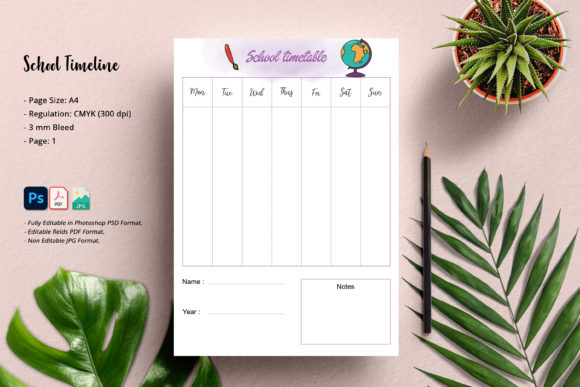
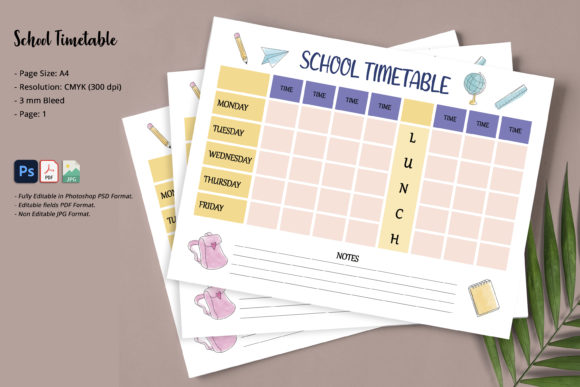
For creators and business owners producing physical planners or educational handouts, technical specifications are non-negotiable. The quality of a school timetable is often judged by its print fidelity. Utilizing vector shapes and icons ensures that every line and curve remains mathematically perfect regardless of scaling. Unlike raster images that pixelate when resized, vectors retain their sharpness, which is essential for maintaining a professional appearance in A4 formats. When working with files configured at 300 DPI in CMYK color mode, designers guarantee that what is seen on screen translates accurately to paper. This color space is specifically calibrated for commercial and home printing, preventing the dullness or color shifts that often occur when RGB web files are sent to press.
The inclusion of a 3 mm bleed is another critical technical detail that separates amateur outputs from professional resources. Bleed allows for slight mechanical variations during the trimming process, ensuring that color blocks and background elements extend seamlessly to the edge of the page without leaving unsightly white borders. For users editing these templates, understanding these parameters prevents costly reprinting errors. Additionally, the separation of editable fields from static design elements streamlines the production workflow. By keeping the structural design locked and only opening specific text areas for modification, users preserve the integrity of the original layout while still achieving necessary customization. This balance of rigidity and flexibility is what makes a template truly useful in high-volume or fast-paced environments.
Workflow Efficiency Through Layered PSD Architecture
Efficiency in design is largely determined by how a file is constructed. For those working within the Adobe ecosystem, compatibility and layer organization define the user experience. A robust school timetable template supports versions as far back as Photoshop CS2 while remaining fully optimized for CS6 and newer Creative Cloud releases. This backward compatibility is vital for freelancers and small businesses operating on legacy hardware or avoiding subscription models. It democratizes access to high-quality design assets, ensuring that budget constraints do not limit professional output. However, version support is only half the equation; intelligent layer naming and grouping are equally important.
When all vector icons and shapes are organized logically, changing colors becomes a matter of seconds rather than hours. Smart Objects and adjustment layers allow for global changes across multiple elements simultaneously. For example, if a school’s branding changes from blue to green, a well-structured PSD allows the user to update the entire timetable’s accent color with a single click. This capability transforms the template from a static document into a dynamic system. For educators updating schedules term-by-term or businesses creating seasonal planner inserts, this time-saving feature directly impacts profitability and productivity. The ability to manipulate vector properties non-destructively means that revisions can be made endlessly without degrading image quality, supporting an iterative design process that responds to real-time feedback.
Hybrid Usability: Editable PDFs vs. Static Formats
The modern user base is fragmented across different skill sets and software access levels. Recognizing this, versatile timetable resources now adopt a hybrid distribution model. While the master PSD file offers total creative control for designers, the Acrobat Reader compatible PDF serves the end-user who simply needs to input data. These editable field PDFs are distinct from standard documents; they contain form fields that accept text input without altering the underlying design. This accessibility is crucial for parents, students, and administrative staff who may not own or know how to use Photoshop. They can type class names, times, and notes directly into the file and print immediately, bridging the gap between professional design and consumer utility.
Conversely, the inclusion of a non-editable JPG provides a universal fallback. This format is ideal for quick previews, email attachments, or digital displays where interaction is not required. It ensures that even if a recipient lacks PDF readers or design software, they can still view the schedule. This multi-format approach maximizes the asset's reach and utility. For bloggers and content creators, the JPG serves as social media content or blog imagery, while the PDF acts as a downloadable lead magnet. The PSD remains the source of truth for future updates. Understanding these distinctions helps users select the right file for the right task, preventing frustration and ensuring that the school timetable functions effectively across every touchpoint in the user journey.
Practical Applications for Diverse User Groups
The utility of a professionally designed, minimal school timetable transcends its name. For educators and administrators, it serves as a standardized communication tool that reduces confusion among students and parents. Consistent formatting across departments or grade levels creates a cohesive institutional identity. For freelancers and solopreneurs, the grid structure offers a proven method for time-blocking. Adapting a school timetable for client meetings, deep work sessions, and administrative tasks leverages decades of pedagogical research on attention spans and rest intervals. The visual familiarity helps enforce boundaries in an otherwise unstructured workday.
Parents and homeschoolers benefit from the customization potential. Being able to color-code subjects, add custom icons for chores or therapy appointments, and adjust font sizes for younger readers makes the schedule an inclusive family tool. For marketers and digital product sellers, these templates represent low-overhead inventory. Because they are vector-based and easily recolored, a single master file can generate dozens of unique SKU variations targeting different niches—from university students to corporate trainees. The key to success lies in respecting the user’s time; providing a file that is technically sound, aesthetically restrained, and immediately usable builds trust and authority. In a marketplace saturated with complex, unusable designs, simplicity backed by professional specifications is the ultimate competitive advantage.
Ultimately, the enduring popularity of the school timetable lies in its promise of order. As our lives become increasingly complex, the tools we use to manage them must become simpler and more reliable. By combining timeless organizational logic with modern technical standards like vector scalability, CMYK print readiness, and layered editing capabilities, these templates offer more than just a place to write down times. They provide a sustainable framework for navigating daily life with intention and clarity. Whether printed on premium stock with proper bleed or filled out digitally via Acrobat, a well-executed timetable remains an indispensable artifact of productive living.